
Most people paying for their own care find out the price afterwards. That has not been the rule since 2022, and the gap between the rule and what actually happens at the front desk is where a lot of money goes.
The document you are owed
If you do not have insurance, or you have it and are choosing not to use it for this particular thing, a provider is required to give you a written estimate before scheduled care. It has to itemise what they expect to charge, list the billing codes, and name the provider.
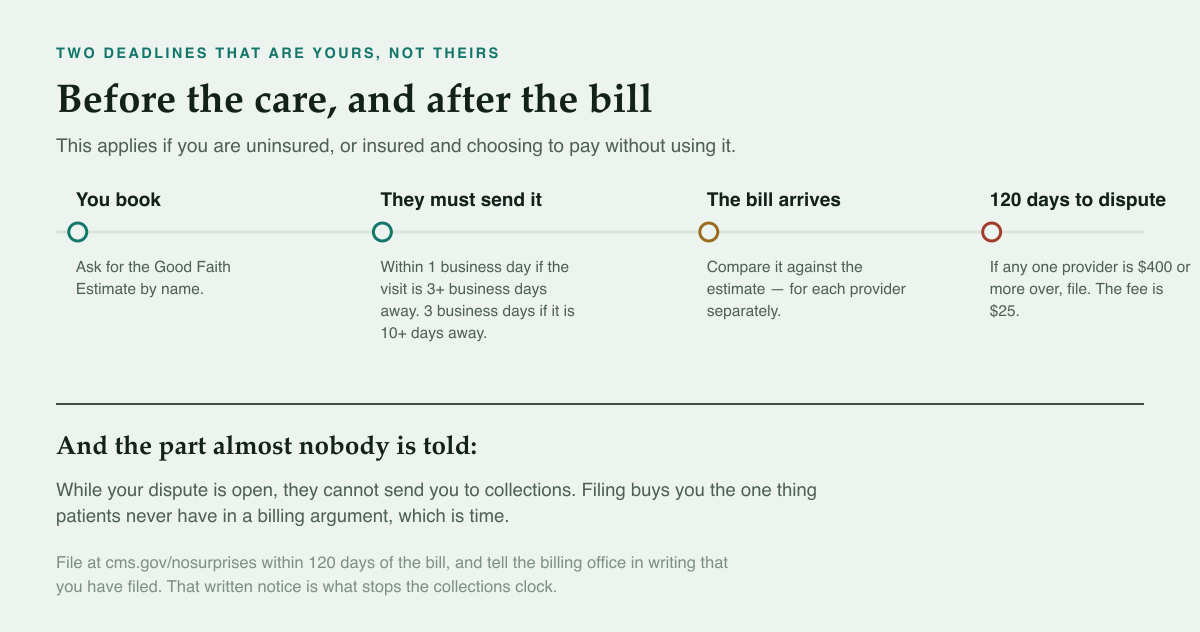
You are supposed to get it automatically. In practice, ask for it by name — *"I'm self-pay, I'd like the Good Faith Estimate"* — because the phrase tells the person in front of you that this is a legal document and not a favour.
The timing is fixed, and knowing it is what makes the request stick:
| When you book | When the estimate is due | |---|---| | At least 3 business days ahead | Within 1 business day | | At least 10 business days ahead | Within 3 business days | | Any time you ask for one | Within 3 business days |
Get it in writing, and keep it. It is the only thing that makes the next part possible.
The $400 rule
If the bill comes in $400 or more above the estimate, you can challenge it through a formal federal process — Patient-Provider Dispute Resolution. A reviewer who is neither you nor the provider looks at the estimate and the bill and decides what you owe.
Three details decide whether it helps you:
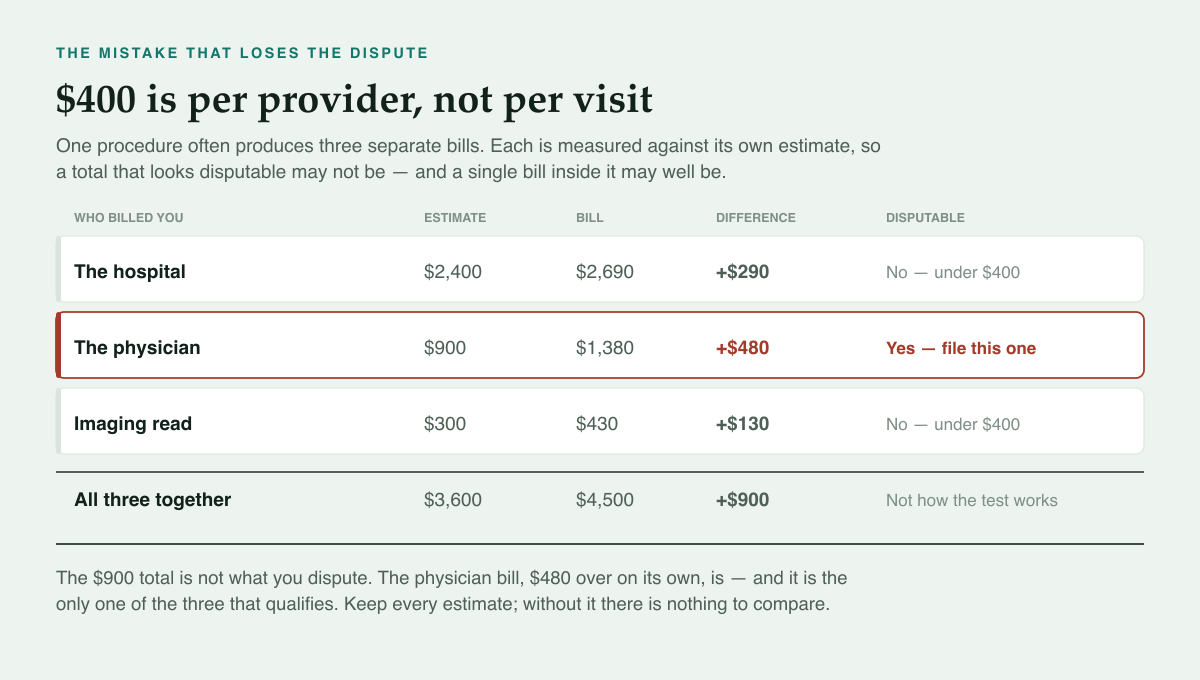
It is per provider, not per visit. One procedure often produces separate bills from the hospital, the physician, and whoever read the imaging. Each is measured against its own estimate. A $300 overage on each of three bills is not disputable as $900 — but any single one crossing $400 is.
You have 120 days from receiving the bill. That is generous compared with most appeal windows, and it is also easy to lose track of while you are arguing on the phone. Note the date the bill arrived.
The fee is $25. Set deliberately low, and refunded in some circumstances.
The part that matters even if you lose
While the dispute is pending, the provider cannot pursue collections.
This is the most useful sentence in the whole rule and the least advertised. A disputed bill cannot be sent to a collections agency, cannot be escalated, and cannot be used to pressure you into paying an amount you believe is wrong while you are still arguing about it. Filing buys you the thing patients almost never have in a billing argument, which is time.
How to actually file
1. Keep the estimate and the bill together. You will need both, and the dispute is close to impossible without the estimate. 2. Check the difference for each provider separately. Not the total. 3. File through the federal portal at [cms.gov/nosurprises](https://www.cms.gov/nosurprises), within 120 days of the bill. Pay the $25. 4. Tell the provider's billing office in writing that you have filed, and keep the confirmation. That is what stops the collections clock.
What this does not cover
Insured patients using their insurance. The law also promised you an Advance Explanation of Benefits — a real estimate before scheduled care, based on your own plan — but that part is not being enforced yet, pending rules the federal agencies still have not finished. So the strong protection today belongs to the self-pay patient, which is an odd inversion: the person with no coverage has better price rights than the person paying premiums.
Emergencies. None of this applies to emergency care, and it should not stop you going. Separate protections cover surprise emergency bills.
One last thing worth knowing before you choose to pay cash: money you pay outside your insurance usually does not count toward your deductible. If you are likely to hit that deductible this year, the cheaper sticker price can be the more expensive choice. Ask which number you are really comparing before you decide.
Sources
- [CMS — understanding the Good Faith Estimate and the dispute resolution process](https://www.cms.gov/marketplace/technical-assistance-resources/understanding-good-faith-estimate-and-dispute-resolution-process.pdf)
- [CMS — No Surprises: rules and fact sheets](https://www.cms.gov/nosurprises/policies-and-resources/overview-of-rules-fact-sheets)
- [Burr & Forman — Good Faith Estimates under the No Surprises Act](https://www.burr.com/newsroom/articles/the-no-surprises-acts-good-faith-estimates-what-every-provider-needs-to-know)