
There is a program at most American hospitals that can cut a bill in half or make it disappear entirely. It is not a negotiation trick and it is not charity in the hat-in-hand sense. It is a written policy the hospital is legally required to have, with an application form the hospital is legally required to give you for free. It goes by two names — financial assistance, or charity care.
Here is what almost nobody tells you at discharge: the burden of finding it is entirely on you.
Why the hospital has to help
About 3 in 5 community hospitals in the US are nonprofits — 2,984 of 5,121, by the American Hospital Association's latest count. Nonprofit means they pay no federal income tax, and since the Affordable Care Act, the tax code attaches conditions to that. A section of the law called 501(r) requires every nonprofit hospital to have a written financial assistance policy, to post it online with a plain-language summary, and to hand you a paper copy free if you ask.
The same law does three more things worth knowing.
- Qualifying patients cannot be charged full sticker price. If you are eligible under the policy, the hospital must charge you no more than the amounts it generally bills insured patients — the discounted rates, not the inflated "chargemaster" numbers that appear on bills.
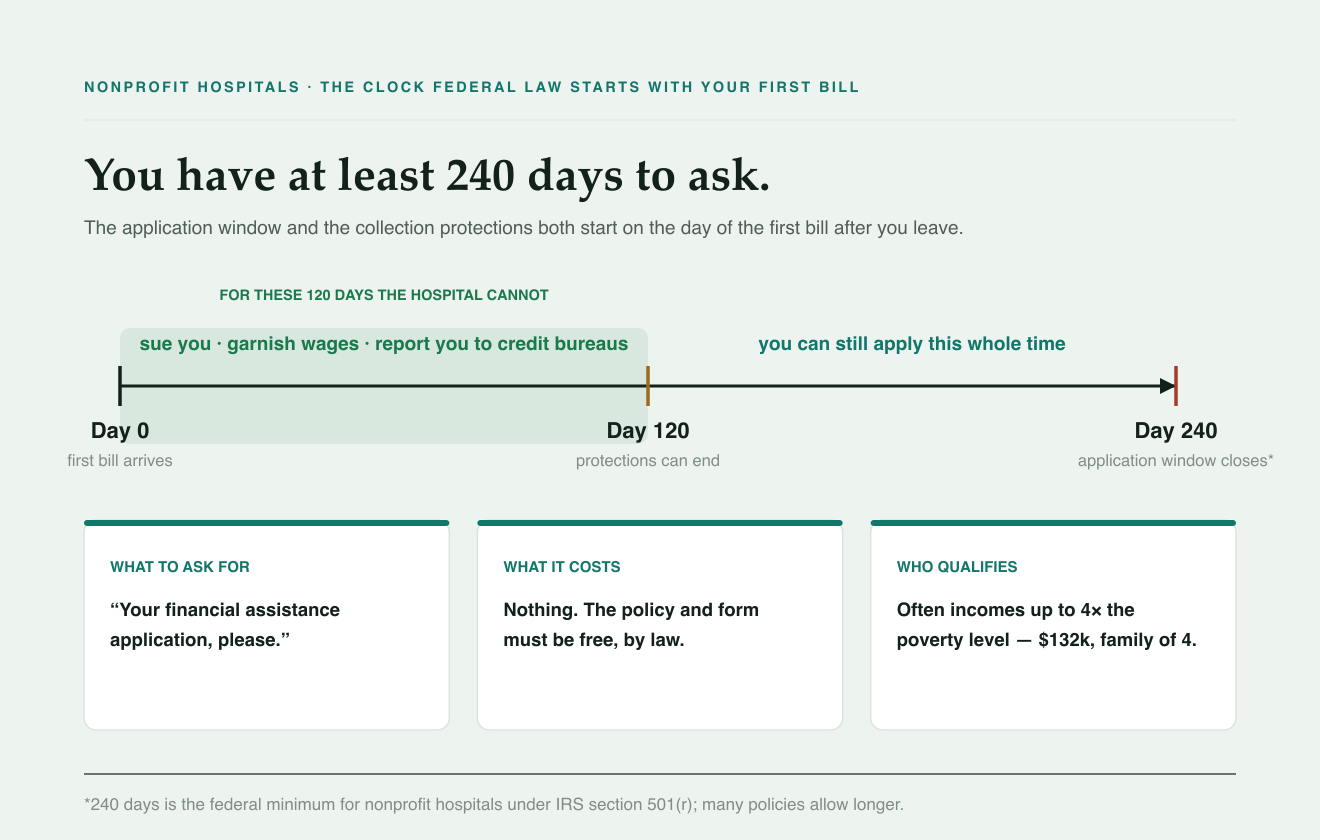
- You get at least 240 days from the first bill to apply. That is roughly eight months. A bill you have been ignoring since spring is probably still inside the window.
- The hospital cannot rush to punish you. For at least 120 days after the first bill it cannot take what the law calls extraordinary collection actions — no lawsuit, no wage garnishment, no reporting you to credit bureaus — and it must make a real effort to check whether you qualify for assistance before doing any of that, with 30 days of written warning first.
For-profit and government hospitals are not covered by this federal rule, but many have similar policies anyway, and some states require every hospital to offer one. The only way to find out is the same either way: ask for the policy.
You probably earn less than the limit thinks you do
People hear "charity care" and assume it means destitute. The actual thresholds say otherwise. Hospital policies commonly cover incomes up to two, three, or four times the federal poverty level — and in 2026 the poverty level is $15,960 for one person and $33,000 for a family of four. At a hospital with a 400 percent threshold, a family of four earning $132,000 can qualify for free or discounted care. Every hospital sets its own numbers, which is exactly why the policy is worth two minutes of reading.
And insurance does not disqualify you. At many hospitals the policy applies to your share of the bill after insurance pays — the deductible, the coinsurance, the out-of-network remainder. If your share of a hospital stay is four thousand dollars and your income is under the hospital's limit, that four thousand is what the application is for.
The scale of what goes unclaimed is hard to believe. Dollar For, a nonprofit that helps patients file these applications, estimates hospitals bill patients about $14 billion every year that their own policies say should have been reduced or waived — and that only about 29 percent of people with hospital bills they cannot afford ever learn about the program, apply, and receive help. In their survey, the most common reason people did not apply was simply that no one told them it existed.
How to ask
- Find the policy. Search the hospital's name plus "financial assistance policy" — the law requires it to be online. Read the income table. That is the whole eligibility answer.
- Ask for the application in writing. Call billing or write through the portal: "Please send me your financial assistance application and the plain-language summary of your policy." They must provide it free.
- Apply even if the bill is old, paid down, or in collections. The window is at least 240 days from the first bill, and an application generally pauses the pressure while it is decided.
- Send what they ask for and keep copies. Usually pay stubs or a tax return. Note the date you sent it.
- If you are denied, ask why in writing. Income counted wrongly, or a missing document, is fixable. And a denied application still proves you engaged, which matters if collections ever escalate.
One more honest tip from the physician's side of the desk: the billing office is not hiding this out of malice, but no part of the system is paid to volunteer it. The program exists because the hospital's tax exemption depends on it. You are not asking for a favour. You are asking the hospital to apply its own published policy to your bill — and the single most expensive thing you can do is never ask.
Sources
- IRS — Financial assistance policy and emergency medical care policy, Section 501(r)(4). irs.gov/charities-non-profits
- IRS — Limitation on charges, Section 501(r)(5), and billing and collections, Section 501(r)(6). irs.gov/charities-non-profits
- American Hospital Association — Fast Facts on US Hospitals, 2026. aha.org/statistics/fast-facts-us-hospitals
- Dollar For — Bridging the Chasm report on unclaimed charity care. dollarfor.org
- HHS — 2026 Poverty Guidelines. aspe.hhs.gov/topics/poverty-economic-mobility/poverty-guidelines